
Resin vs Sintered vs Semi-Metallic Brake Pads UK 2026: Which to Fit
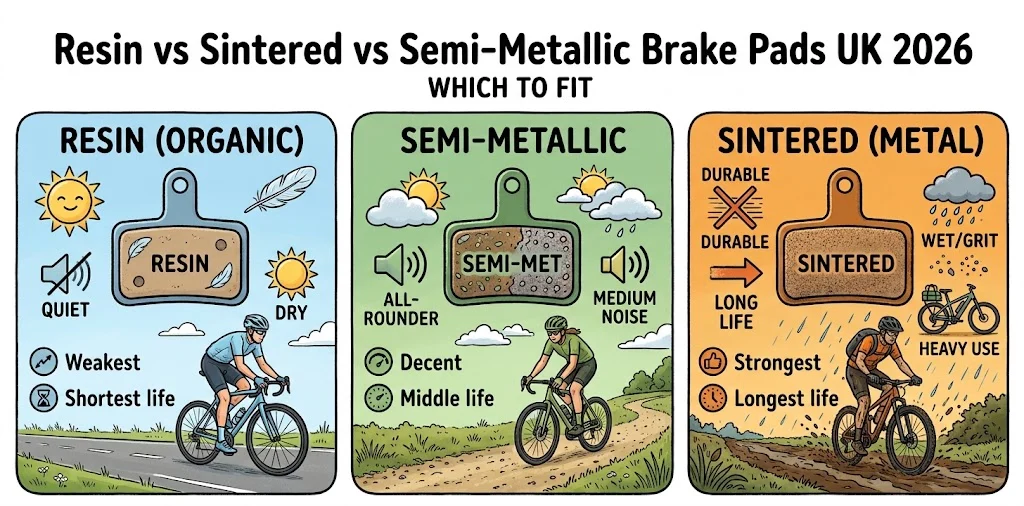
Resin vs sintered brake pads: the compound you fit decides how quiet your brakes are, how well they grip in the wet and how soon you are buying the next set. Semi-metallic sits in the middle. Here is how to choose, from the workshop bench rather than the packaging.
The short answer on resin vs sintered brake pads: resin for quiet, dry riding; sintered for wet UK winters, heavy bikes and long descents; semi-metallic if you want a bit of both – but check what the seller means by “semi-metallic”.
Disc brake pads are not one product with different colour packets. They are three different friction materials, and swapping one for another changes the noise, the bite, the wet-weather grip and how fast the pad disappears. The question I get asked most at the bench is not “which brand?” but “why do my pads wear out so fast?” – and nine times out of ten it is a compound that does not suit how and where the bike is ridden.
Below: how resin vs sintered brake pads actually differ, what each compound does, which one suits your riding, why compound is only half the buying decision, and where pad squeal comes into it.
Reader-supported: we may earn a commission at no extra cost to you. Gorilla pads review · Fix squeaky disc brakes · All buying guides
At a Glance
Sellers use these names loosely – see the semi-metallic section.
On this page
Resin vs Sintered Brake Pads: Which Compound Should You Fit?
If you only read one section, read this. For resin vs sintered brake pads, pick the line that sounds like your riding.
Resin vs Sintered Brake Pads (and Semi-Metallic): The Comparison
This is the whole resin vs sintered brake pads argument on one screen. The sections after it explain each column.
| Resin (organic) | Semi-metallic | Sintered (metal) | |
|---|---|---|---|
| Noise | Quietest | Middle, varies by maker | Noisiest, esp. wet or cold |
| First bite | Strong straight away | Good | Needs bedding in |
| Wet and grit | Weakest | Decent | Strongest |
| Pad life | Shortest | Middle | Longest |
| Heat and fade | Fades first on long descents | Better than resin | Best, but passes more heat to the caliper |
| Best for | Dry road, light riders | Mixed, year-round | UK winter, e-bikes, descents |
RESIN
Quiet, instant bite, no warm-up. Wears fastest and struggles when it is wet and gritty.
SEMI-METALLIC
A blend of the two. A sensible middle, but the mix varies from maker to maker.
SINTERED
Hard-wearing and strong in the wet. Noisier, slower to bed in, and hotter at the caliper.
Resin (Organic) Brake Pads
Resin pads are friction material held together in a resin binder. You will also see them sold as “organic”, which is the American term and still turns up on UK listings. They are the quiet, sharp-feeling option: you pull the lever and they grip, with no warm-up needed.
The trade-offs are the ones that matter in Britain. Resin pads wear faster than the other two, they do not like wet and dirty conditions, and on a long hot descent the resin can overheat and fade. They can also glaze – the surface hardens and shines – if they are dragged or overheated. Shimano’s resin pads with cooling fins (the L05A-RF is the example you will see most) add a finned backing plate specifically to cut that fade.
Workshop take
I have fitted resin pads to plenty of commuter bikes. Customers love the instant bite, then come back when they have worn out in a wet winter. If your riding is mostly dry or the bike lives indoors, resin is a good choice. If it commutes in November, it probably is not.
Semi-Metallic Brake Pads
A semi-metallic pad mixes metal particles into a resin binder, so it sits between the other two. You get more heat tolerance and wet-weather grip than resin, without every bit of the noise of a full sintered pad. For one set that has to cope with the whole year, it is often the sensible answer.
The semi-metallic naming trap
This is the part nobody warns you about. There is no strict industry definition, and sellers use the label loosely. Some use “semi-metallic” for a genuine metal-and-resin blend. Others use it to describe what is really a resin pad. Two packs both labelled semi-metallic can behave differently, because the blend is each manufacturer’s own recipe.
So do not buy on the word alone. Read the maker’s own description of the compound, and treat any listing that will not say what is in it with suspicion.
Workshop take
In my experience a good semi-metallic is the best-value pad for most riders. I have fitted dozens to Shimano MT-series and 105 brakes without complaints – the Gorilla semi-metallic I wrote up in my review is the one I reach for most.
Sintered (Metal) Brake Pads
Sintered pads are made from metal particles fused together under heat and pressure, which is what “sintering” means. The result is hard, durable and very tolerant of water and heat. That is why, in the resin vs sintered brake pads argument, sintered is the usual advice for wet UK winters, heavy e-bikes, and long descents where a resin pad would fade.
You pay for it in other ways. Sintered pads are noisier, particularly when cold or wet. They take longer to bed in, so the first few rides feel less sharp. And they pass more heat through the pad into the caliper, which is the reason finned pads and rotors exist.
Workshop take
For British winter riding, sintered is my default. The wet-weather performance is excellent and customers do not come back complaining about pad life. The noise is the cost – tell anyone you fit them for that they will be louder than the pads they replaced.
Resin vs Sintered Brake Pads: Do They Wear Out Your Rotors?
Everyone repeats that, in the resin vs sintered brake pads debate, the sintered set chews through rotors faster. It is a reasonable suspect, because a harder pad is more abrasive, and resin is commonly described as gentler. But I have not found measured wear data to back it up, and I would rather tell you that than pass it on as fact.
What you can do is check. Most rotors have a minimum thickness stamped on them, so measure it with calipers at every service. A pronounced lip at the outer edge of the braking track is the other sign. If you are worried, ask me to measure yours when the bike is in.
Resin vs Sintered Brake Pads for Your Kind of Riding
The same resin vs sintered brake pads decision as the checklist at the top, laid out by riding type so you can find yours quickly.
| Your riding | Fit | Why |
|---|---|---|
| Year-round commuter | Sintered | Wet roads and grit are exactly where resin wears out fastest |
| Dry-weather road rider | Resin | Quiet and sharp, and you are not asking it to survive the wet |
| Gravel, mixed conditions | Semi-metallic | Copes with mud and dry days without the full sintered noise |
| E-bike or loaded touring bike | Sintered or semi-metallic | More weight means more heat and more wear |
| Mountain bike, long descents | Sintered | Resin fades first when the brakes stay hot |
| Light rider, dry trails | Resin | You get the best feel and the pads last longer for you |
Compound Is Only Half: Match the Pad to Your Brake
You can win the resin vs sintered brake pads decision and still buy the wrong pad. Disc brake pads are shaped for specific calipers, and Shimano, SRAM, Hope, Magura and Tektro do not share one pattern. Work in this order.
Shop listings are a useful clue to what a code means – the L05A-RF and B05S are listed as resin pads and the G04S as sintered, for example – but they are not a substitute for the caliper’s manual. Compatibility lists differ between retailers, so if a shop and the manufacturer disagree, go with the manufacturer.
If you are not sure, bring the bike in. Checking a caliper takes me seconds; a wrong set of pads costs you a trip back to the shop.
Bedding In, Squeal and When to Replace
Whichever you choose from resin vs sintered brake pads, bed them in. New pads and rotors need a run of firm, controlled stops to lay down an even film of pad material on the rotor, and until that happens they can be weak, grabby or noisy. Sintered pads take longest.
If your new pads squeal anyway, the cause is usually one of three things: oil or lube on the pad or rotor, glazing, or poor bedding-in. Contamination is the most common, and a single drop of chain lube is enough. I have written the full diagnosis, step by step, in how to fix squeaky disc brakes, so start there before replacing anything. And if the lube is the culprit, a drip-style lube is much easier to keep off the brakes – my chain lube guide covers the options.
On replacement: check your pads whenever the wheels are out and every service. My rule, as in the squeak guide, is that pads worn down to around 1.5mm of material get replaced, not sanded and hoped over. Wet, gritty winters eat resin sets much faster than summer riding does, which is another reason sintered earns its place on a commuter.
Brake Pad Brands Worth Knowing
Resin vs sintered brake pads is a question of compound, not brand, so this is not a ranking – the right pad is the one that fits your caliper in the compound you want – but these are the names that come through my workshop.
STARTING POINT: RESIN
The Shimano resin pad that is listed for your own caliper. Dry-weather and quiet-riding bikes.
STARTING POINT: SINTERED
A sintered pad listed for your caliper. Wet winters, e-bikes and long descents.
Brake Pad FAQs
Pads worn, noisy or the wrong type?
Bring the bike to the Bournemouth workshop. I will check the pads, the rotors and the calipers, and fit the right set. Free collection and delivery within 12 miles of BH11.
Related Articles & News!

Nothing ruins a peaceful ride quite like squeaky disc brakes. If your bike's disc brakes are making an ear-piercing squeal every time you slow [...]
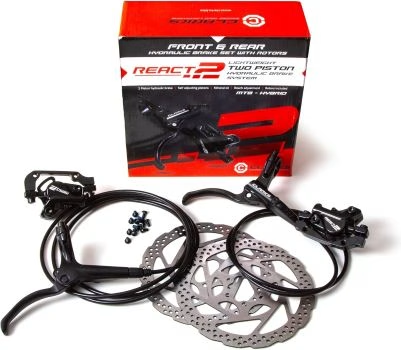
Clarks Cycle Systems React-2 Piston Hydraulic Disc Brake - Suitable for most mountain bikes. Find the best hydraulic disc brake deals.

Tested by mechanic: Gorilla Brake Pads for Shimano, SRAM & more. UK brand, 40% cheaper than OEM. Get 25% off with exclusive code.