
Best Bike Inner Tubes UK 2026

Punctures. The curse of every cyclist. After 30 years fixing bikes in Bournemouth, we’ve fitted thousands of inner tubes and seen the technology transform completely. Find the Best Bike Inner Tubes 2026 From TPU to the normal traditional innertubes. They now weigh less than your energy gel. Self-sealing tubes fix punctures while you ride. And traditional butyl tubes remain the reliable workhorse for most UK cyclists.
Whether you’re chasing watts on a Sunday club run, commuting through Dorset’s glass-strewn bike lanes, or carrying a spare for emergencies, choosing the right inner tube matters more than you’d think. The wrong tube costs you speed, comfort, and potentially leaves you stranded. Based on thousands of puncture repairs and real-world testing, these are the inner tubes that actually deliver for UK cyclists in 2026.
Our Top Picks – Best Inner Tubes UK 2026
- Best TPU Overall: Tubolito Tubo Road – 38g, 2x puncture resistance (£25-30)
- Best Value TPU: Schwalbe Aerothan – German quality, rim brake safe (£18-24)
- Best Self-Sealing: Slime Smart Tube – Seals punctures up to 3mm (£12-18)
- Best Standard: Continental Race 28 – Industry benchmark butyl (£6-10)
Table Of Contents
Why Your Inner Tube Choice Matters
- Rolling resistance – TPU tubes can save 2-4 watts per wheel vs standard butyl
- Weight savings – TPU weighs 30-40g vs 100g+ for standard tubes
- Puncture protection – Self-sealing tubes fix holes up to 3mm automatically
- Air retention – TPU holds pressure for weeks, latex loses 10-20psi overnight
- Pack size – TPU tubes pack 78% smaller for saddle bag storage
The 2025/2026 trend: TPU inner tubes are the big performance upgrade this year. Cycling Weekly called them “the performance trend of 2025” as riders move away from tubeless hassles. Whether you want speed, convenience, or puncture protection, there’s now a tube designed for your specific needs.
UNDER £10
Standard Butyl
– Continental, Schwalbe
– 80-110g weight
– Reliable workhorse
– Easy to repair
£10 – £18
Self-Sealing
– Slime Smart Tubes
– Puncture protection
– Heavier but safer
– Great for commuters
£18 – £25
Mid-Range TPU
– Schwalbe Aerothan
– Pirelli SmarTube
– 40-65g weight
– Best value zone
£25+
Premium TPU
– Tubolito S-Tubo
– Ultra-light 23-38g
– Lowest rolling resistance
– Race-day performance
Best TPU Inner Tubes UK 2026
TPU (thermoplastic polyurethane) tubes are the biggest performance trend in cycling right now. They weigh 60-70% less than standard butyl tubes, offer lower rolling resistance comparable to latex, and hold air for weeks instead of hours. Cycling Weekly, road.cc, and BikeRadar all rate these as genuine performance upgrades. The trade-off? Higher price and they require special patch kits for repairs.
Tubolito Tubo Road 700C
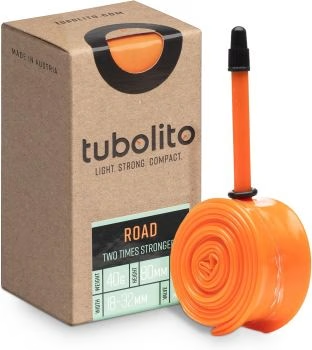
Best Overall TPU Tube
The original TPU tube pioneer from Austria. Just 38g weight saves 70g rotating mass per wheel compared to standard tubes. 2x puncture resistance in independent testing. Holds air for weeks. Reviewed by road.cc as “a very viable alternative to tubeless.” Available in 42mm, 60mm and 80mm valve lengths. Works with disc and rim brakes.
Price: £25 – £30
Schwalbe Aerothan Road
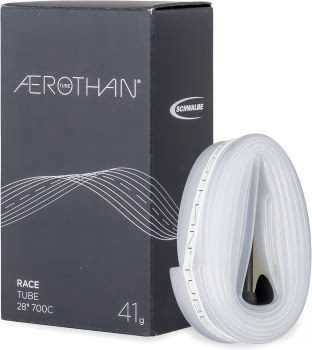
Best Value TPU – Rim Brake Safe
German engineering developed with chemical giant BASF over 5 years. 41g weight, 40% lighter than Schwalbe’s own Extra Light tubes. Heat resistant to 150°C – certified safe for rim brakes unlike some TPU competitors. BikeRadar praised the “improved puncture protection” and road.cc noted “beautiful ride quality.” Fully recyclable construction.
Price: £18 – £24
Pirelli P Zero SmarTube

Best TPU for Durability
F1 tyre expertise applied to cycling. Pirelli offers the broadest TPU range with six versions for different needs. Cycling Weekly praised the durability as “the ideal winter butyl replacement.” Removable valve core, incredibly compact pack size. Available for road, gravel and MTB. Known for excellent longevity in real-world UK conditions.
Price: £20 – £28
Best Self-Sealing Inner Tubes UK 2026
Self-sealing tubes contain sealant that automatically plugs punctures up to 3mm as they happen. Perfect for UK commuters facing glass, thorns and debris on cycle paths. Heavier than standard tubes but the peace of mind is worth it for daily riders. Road.cc tested Slime tubes and found “no punctures in a few hundred miles of winter riding on dirty Cotswold lanes.”
Slime Smart Tube 700C

Best Self-Sealing Tube
Factory-filled with Slime sealant that instantly seals punctures up to 3mm for up to 2 years. Road.cc testing confirmed “the Slime quickly repairs holes” with only 15 psi pressure drop. Available for 700c road bikes in multiple widths. Heavier at 170g but eliminates most puncture worries. Essential for winter commuting.
Price: £6-12
Slime Smart Tube 26″
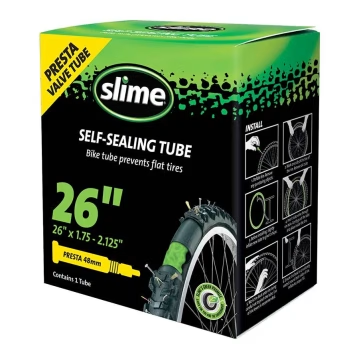
Best for MTB & Hybrid Bikes
Same proven Slime technology for 26″ wheels. Factory-filled sealant continuously protects against thorns, glass and punctures for up to two years. Ideal for hybrid bikes and older mountain bikes still running tubes. Amazon reviewers praise them for “getting home when had a puncture” and “holding pressure very well.”
Price: £8-12
Slime Smart Tube 29″
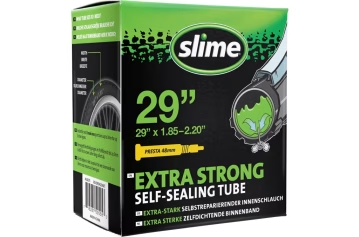
Best for Modern MTB
29″ version for modern mountain bikes with Schrader valve. Self-sealing protection against trail debris, thorns and sharp rocks. Works continuously for up to 2 years. Extra strong construction handles off-road abuse. Reviewers note “significant reduction in punctures” and “saved me money” on repairs.
Price: £12-18
Best Standard Butyl Inner Tubes UK 2026
Traditional butyl rubber tubes remain the reliable choice for most UK cyclists. Continental and Schwalbe dominate this market for good reason – they’re affordable, easy to repair with standard patch kits, and proven over decades of use. If you’re not chasing marginal gains or don’t want the expense of TPU, these are your best options. Merlin Cycles reviewers describe Continental Race 28 as “the benchmark in bike tubes.”
Continental Race 28
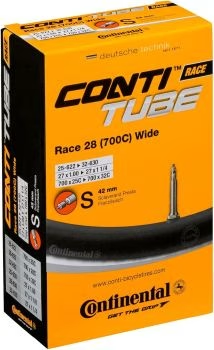
Best Standard Tube – Industry Benchmark
The tube professional mechanics reach for. Seamless mould-cured construction ensures uniform thickness. Available in 42mm, 60mm and 80mm valve lengths for any rim depth. Removable valve core. Amazon UK reviews praise them as “reliable,” “excellent quality” and “never had a puncture.” Multi-packs offer excellent value. The default choice for good reason.
Price: £6-10 (singles) | £15-22 (3-pack)
Continental Race Wide 28
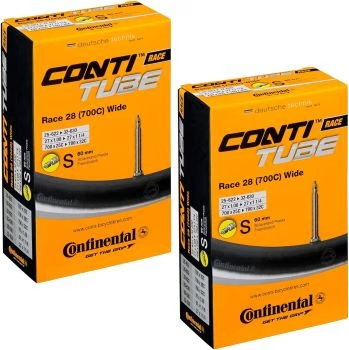
Best for Wider Tyres (25-32c)
Same Continental quality for modern wider road tyres and light gravel. Fits 25mm to 32mm tyre widths – perfect for endurance bikes, all-road setups and winter training tyres. Presta valve with removable core. Multi-packs available. Amazon reviewers confirm “good quality,” “hold air well” and “perfect fit.” Essential as wider tyres become standard.
Price: £6-10 (singles) | £15-22 (3-pack)
Schwalbe 700 x 18-28c Road Bike Inner Tubes
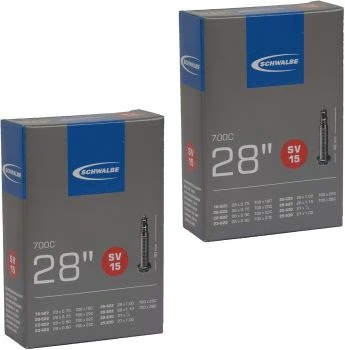
Best German Alternative
Schwalbe’s standard butyl tube with proven reliability. Fits 18-28mm tyres with 40mm Presta valve. Consistent quality from a brand known for puncture-resistant tyres. Used as the benchmark comparison in rolling resistance tests. A solid alternative to Continental if you prefer Schwalbe’s ecosystem.
Price: £12-18
Inner Tube Comparison: TPU vs Self-Sealing vs Standard Butyl
Choosing between tube types depends on your priorities. Here’s how they compare across the factors that matter most to UK cyclists.
Weight Comparison
- TPU tubes: 23-65g depending on model (Tubolito S-Tubo = 23g)
- Standard butyl: 80-110g (Continental Race 28 = ~100g)
- Self-sealing: 150-200g (Slime Smart Tube = ~170g)
Verdict: TPU saves 140g+ across both wheels – significant rotating weight.
Rolling Resistance
According to Bicycle Rolling Resistance testing:
- Latex tubes: Lowest rolling resistance (but lose air overnight)
- TPU tubes: Very close to latex, significantly better than butyl
- Standard butyl: Baseline performance
- Self-sealing: Slightly higher due to sealant weight
Verdict: TPU offers latex-like performance with butyl-like convenience.
Puncture Protection
- Self-sealing: Best – automatically seals holes up to 3mm
- TPU: Good – 2x puncture resistance vs butyl (Schwalbe testing)
- Standard butyl: Baseline – relies on tyre protection
Verdict: Commuters should consider self-sealing. Performance riders benefit from TPU’s resistance without weight penalty.
Air Retention
- TPU: Excellent – holds pressure for weeks
- Standard butyl: Good – check weekly
- Self-sealing: Good – similar to butyl
- Latex: Poor – loses 10-20 psi overnight
Verdict: TPU wins for low-maintenance riding.
Repairability
- Standard butyl: Easiest – standard patches work perfectly
- TPU: Requires special TPU patch kits (Tubolito Flix-Kit, Park Tool GP2)
- Self-sealing: Difficult – sealant makes patching messy
Verdict: Butyl wins for roadside repairs. Carry a butyl spare even if running TPU.
How to Choose the Right Valve Length
Getting valve length wrong is one of the most common inner tube mistakes. Here’s how to get it right.
Valve Length Guide
- 42mm valve: Standard aluminium rims up to 30mm deep
- 60mm valve: Mid-profile carbon/aluminium rims 30-50mm deep
- 80mm valve: Deep section aero wheels 50mm+ deep
The 15mm Rule
You need at least 15mm of valve stem above the rim to attach a pump head. Simple calculation: Valve length minus rim depth = available stem. If the result is less than 15mm, go longer.
Valve Extenders
If you have deep rims and only 42mm valve tubes available, valve extenders can help. However, they add a potential failure point. For Schwalbe Aerothan tubes (only available in 40mm), extenders are essential for deeper rims.
Presta vs Schrader
- Presta (thin): Standard on road bikes, lighter, higher pressure compatible
- Schrader (car-type): Common on MTB and hybrids, easier to inflate at petrol stations
Most road bike rims are drilled for Presta. Using a Schrader tube requires a larger hole or an adapter.
Frequently Asked Questions About Inner Tubes
Final Verdict: Which Inner Tube Should You Buy?
After three decades in the bike trade and seeing inner tube technology transform completely, here’s our honest assessment for UK cyclists in 2026.
For Performance Riders
Tubolito Tubo Road (£25-30) delivers genuine performance gains. 38g weight, 2x puncture resistance, holds air for weeks. Road.cc calls them “a very viable alternative to tubeless.” If you’re racing, sportive riding, or chasing Strava segments, these make a noticeable difference.
For Best Value Performance
Schwalbe Aerothan (£18-24) offers similar TPU benefits at a lower price. German engineering with BASF, certified safe for rim brakes. BikeRadar and road.cc praise the ride quality and puncture protection. The sweet spot for upgrading from butyl without breaking the bank.
For Commuters
Slime Smart Tube (£12-18) provides peace of mind on British roads. Self-sealing technology handles the glass, thorns and debris that plague UK cycle paths. Heavier than performance options, but the puncture protection is worth it for daily riders. Road.cc confirmed they work as claimed.
For Reliability & Value
Continental Race 28 (£6-10) remains the industry benchmark. Trusted by mechanics worldwide, available in every valve length, easy to repair roadside. Multi-packs offer unbeatable value. If you’re not chasing performance gains, these are all you need.
The Bottom Line
Inner tube technology has genuinely improved. TPU tubes offer latex-like performance with butyl-like convenience – that’s a real upgrade, not marketing hype. Self-sealing tubes work for commuters. And Continental Race 28 remains the sensible default.
Match your tube to your riding: performance riders benefit from TPU, commuters from self-sealing, everyone else from proven butyl reliability. Whatever you choose, always carry a spare – and know how to fit it.
Related Articles & News!
Check back soon, nothing related right now!