Best Bike Tools UK 2026: Essential Tools Every Cyclist Needs
After 30 years as a mobile bike mechanic, I’ll tell you this straight: you don’t need a garage full of kit. You need the right tools — compact, reliable, ready when things go wrong. A broken chain 20 miles from home, a loose saddle mid-ride, a flat tyre in the dark. These moments separate prepared cyclists from those calling for a lift.
The best bike tools for UK cyclists aren’t complicated — they’re well-chosen, well-made, and proven on real roads in all weathers. Whether you’re building your first toolkit or filling the gaps in an existing one, this guide covers the tools I actually use servicing bikes across Bournemouth, Poole and Dorset every day.
Best Bike Tools UK 2026 — My Top Picks
- Best Multi-Tool: Crank Brothers Multi-17 — 17 functions, pocket-sized, built for UK roads (£35–45)
- Best Budget: Topeak Mini 20 Pro — 20+ functions, built-in tyre levers, outstanding value (£25–32)
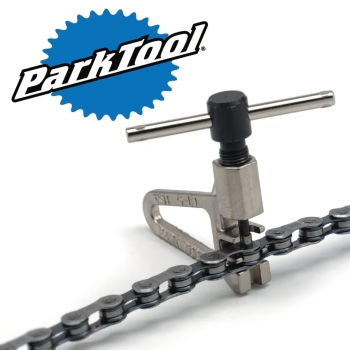
- Best Chain Tool (portable): Park Tool CT-5 Mini — shop quality in a saddle bag (£15–20)
- Best Chain Tool (workshop): Park Tool CT-3.2 — the workshop benchmark, lasts decades (£30–40)
- Best Floor Pump: Lezyne Sport Floor Drive — accurate gauge, all valves, lasts years (£40–55)
- Best Mini Pump: Lezyne Pressure Drive — inline design, won’t snap valve stems (£30–40)
Table Of Contents
Why Every UK Cyclist Needs the Right Tools
- 68% of mechanical failures happen more than 5 miles from home (Cycling UK survey)
- Average mobile rescue callout: £45–80 per visit — a chain tool costs less than one rescue
- DIY maintenance savings: £200–400 per year vs full bike-shop servicing
- Confidence: knowing you can fix most problems changes how far you ride
- Safety: properly torqued bolts don’t come loose mid-ride
STARTER KIT
Under £50
– Multi-tool
– Tyre levers & spare tube
– Mini pump
– Basic roadside cover
HOME MECHANIC
£50–£100
– Floor pump
– Chain tool
– Torque wrench
– Most repairs covered
ENTHUSIAST
£100–£200
– Workshop chain tool
– Cable cutters
– Hex & Torx sets
– Full service kit
PRO WORKSHOP
£200+
– Digital torque wrench
– Bearing presses
– Truing stand
– Everything
Best Bike Multi-Tools UK 2026
Multi-tools are the Swiss Army knife of cycling — 17 to 20 functions in a pocket-sized package. A good multi-tool handles 90% of roadside emergencies: loose stems, slipping saddles, snapped chains, derailleurs out of alignment. These are the two I carry in my van every day.
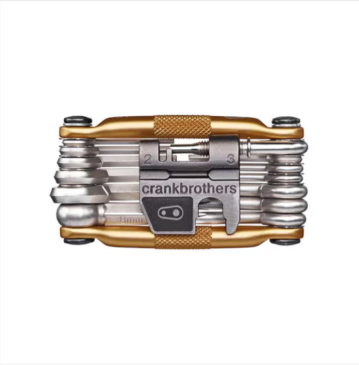
Crank Brothers Multi-17
Best Multi-Tool
The Goldilocks multi-tool — not too bulky, not too minimal. 17 functions covering every bolt on your bike. Chain tool, spoke wrenches in 4 sizes, 2–8mm hex keys, T25 Torx, open-end spanners. High-tensile steel. 155g. The one tool I’d tell every UK cyclist to own.
Price: £35–45 • Weight: 155g • Functions: 17
Topeak Mini 20 Pro

Best Budget Multi-Tool
20+ functions including built-in tyre levers — the outer plates double as levers, which is genuinely clever. Chain tool, T25 Torx, colour-coded hex keys, tyre lever, bottle opener. 153g. Does 95% of what the Crank Brothers does for 60% of the price. Outstanding value.
Price: £25–32 • Weight: 153g • Functions: 20+
What Weather Actually Does to a Multi-Tool:
- Pivot screws corrode in wet UK winters — a drop of light oil every few months keeps tools folding smoothly
- Chrome-vanadium steel will surface-rust if left wet — dry your tool after riding in rain
- Saddle bag storage is better than jersey pockets — tools rattle, fall out, and get forgotten
- Check hex key tips annually — if the ends show any rounding, it’s time to replace rather than risk your bolts
Common Multi-Tool Mistakes:
- Using them for workshop maintenance — hex keys flex under torque and will round expensive bolts. Multi-tools are for emergencies, not home servicing
- Relying on the chain tool alone — a multi-tool chain breaker is fine for emergencies but not for careful new-chain fitting. Buy a dedicated chain tool for workshop use
- Buying cheap generic tools — fake chrome-vanadium wears fast and strips bolt heads. Spend a little more once, buy a quality tool, and it lasts years
Best Chain Tools UK 2026
A snapped chain ends your ride immediately — unless you have a chain tool. The Park Tool CT-5 is compact enough for a saddle bag and handles all roadside chain repairs. The CT-3.2 lives in the workshop for fitting new chains properly. Buy both — together they cost less than a single mobile mechanic callout.
Park Tool CT-5 Mini Chain Tool

Best Portable Chain Tool
Shop-quality performance in a 77g package. Works on all 5–12 speed chains including SRAM AXS and Shimano HG. V-shaped handle gives smooth, controlled pin removal — far better than multi-tool chain breakers. Replaceable pin. I keep one in my van and one in my home toolkit.
Price: £15–20 • Weight: 77g • Fits: 5–12 speed
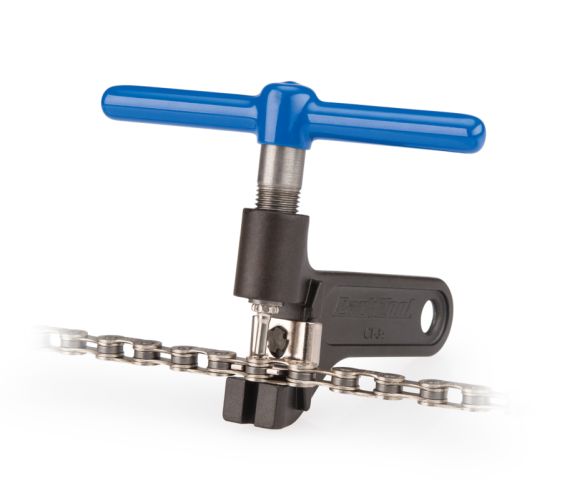
Park Tool CT-3.2 Chain Tool
Best Workshop Chain Tool
The industry benchmark for home mechanics. The sliding arm guides the chain pin perfectly on every push — no guesswork, no bent plates. Smooth, controlled, and accurate. Works on all 5–12 speed chains. My original Park Tool chain breaker from the 1990s still functions. Build quality built to last decades.
Price: £30–40 • Use: Workshop • Fits: 5–12 speed
Chain Tool Tips for UK Cyclists:
- Always push the pin from inside out — pushing from the wrong direction bends the chain plate and ruins the link
- Check chain length before fitting — one link too long and your rear derailleur will struggle on the smallest sprockets
- Use a master link on 10-speed and below — far quicker than pin replacement for roadside repairs
- On SRAM 12-speed: always use SRAM’s specified master link. The tolerances are tight enough that off-brand links can fail under load
Common Chain Mistakes to Avoid:
- Never force a stiff joining link — work it gently side to side between your thumbs. Forcing it snaps the link
- Don’t reuse press-fit pins on Shimano chains — once pressed, the pin is single-use. Always fit a new pin
- Don’t skip chain checking — a worn chain stretches and accelerates cassette and chainring wear. A £10 chain checker saves £100+ in drivetrain costs
Best Bike Torque Wrench UK 2026
If you have carbon components — frame, bars, seatpost, or stem — a torque wrench is non-negotiable. Over-tighten carbon and it crushes with no warning. Under-tighten and components slip or fail mid-ride. The D-Torq DX brings digital precision to home mechanics at a sensible price.
Topeak D-Torq Wrench DX

Common Bike Torque Settings
- Stem face plate bolts: 5–6 Nm (check cap first)
- Handlebar clamp bolt: 5–6 Nm
- Seatpost clamp: 4–5 Nm (carbon seatpost: 3–4 Nm)
- Disc rotor bolts: 6 Nm
- Brake caliper bolts: 6–8 Nm
- Pedals: 35 Nm
Always check the manufacturer’s specification on the component — figures vary. Torx bolts on carbon components often have lower specs than aluminium equivalents.
Best Digital Torque Wrench
Digital precision at an accessible price. LCD display with LED warning light alerts you exactly when target torque is reached. Range 4–20 Nm covers all common bike bolts. Includes 3, 4, 5, 6, 8mm hex keys and T25 Torx. Auto power-off. Everything a home mechanic with carbon components needs.
Price: £65–85 • Range: 4–20 Nm • Accuracy: ±4%
Torque Wrench Tips:
- Use carbon assembly paste on seatposts and bars — it increases friction and lets you use lower torque while maintaining secure grip
- Clean threads before torquing — grit or grease on threads gives inaccurate readings
- Store at the lowest setting — leaving a click-type wrench set to maximum permanently deforms the spring
- The D-Torq DX is a digital wrench — treat it well and it’ll last years without recalibration
Torque Wrench Mistakes to Avoid:
- Never use it as a regular spanner — the torque mechanism is not designed for continuous rotation and will wear out
- Never click past the target — once you hear or feel the click, stop. Continuing to tighten can damage carbon
- Don’t ignore manufacturer specs — guessing torque on carbon components is how expensive frames get cracked. The wrench is cheap insurance
Best Bike Pumps UK 2026
Two pumps, two jobs. The Sport Floor Drive lives at home — inflate before every ride with an accurate gauge and get your pressure right every time. The Pressure Drive lives in your saddle bag — inflate roadside after a puncture when it counts. Don’t cheap out on pumps; a broken valve head or inaccurate gauge ruins your day.
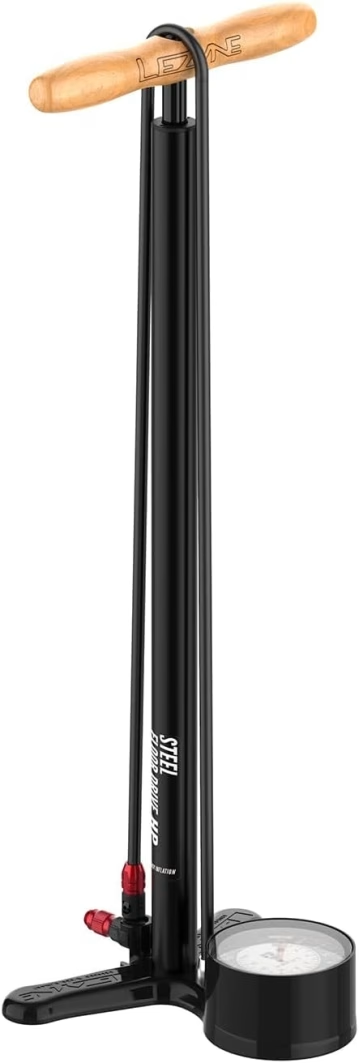
Lezyne Sport Floor Drive
Best Floor Pump
The home-workshop pump done right. Large easy-read gauge accurate to ±2 psi. Dual-head handles Presta and Schrader with no adapters — flip the head and it works on both. Steel barrel, solid base, won’t tip over. I’ve had mine seven years without a seal replacement. Recommended to every customer who asks what floor pump to buy.
Price: £40–55 • Max: 160 psi • Valves: Presta & Schrader
Lezyne Pressure Drive

Best Portable Pump
The portable pump that actually works. The inline design (connection runs in line with the valve rather than perpendicular) eliminates the valve stem stress that snaps stems on cheap mini pumps — a real problem you only notice when it happens miles from home. 120 psi max, 35cc per stroke. Aluminium barrel. 128g. Fits any jersey pocket.
Price: £30–40 • Max: 120 psi • Weight: 128g
Tyre Pressure Guide for UK Conditions:
- Road tyres (23–28mm): 90–110 psi
- Hybrid / commuter (35–42mm): 60–80 psi
- Mountain bike (2.0–2.4″): 25–35 psi (tubeless: 20–28 psi)
- Gravel (38–50mm): 40–60 psi
- Check weekly — road tyres lose 5–10 psi per week naturally through the tube wall
Pump Mistakes That End Rides:
- Disconnecting at an angle — always pull a Presta head straight off the valve. Angling it snaps the valve stem off inside the tube
- Inflating to tyre maximum — the max pressure on the tyre sidewall is a burst test figure, not a riding spec. Check manufacturer recommendations
- Using CO₂ on tubeless — CO₂ cartridges react with tubeless sealant and cause it to coagulate. Use a proper pump
- Buying the cheapest mini pump — a £5 pump that breaks roadside is worse than no pump
Bike Tool Buying Guide — What to Look For
Most tools look similar in product photos and specs. Here’s what actually separates kit that lasts 20 years from kit that fails at the worst moment.
Multi-Tools: What the Function Count Really Means
A 17-function multi-tool and a 25-function tool can look similar on spec sheets. What matters is whether those functions are useful. The critical ones for UK cyclists: 2mm, 2.5mm, 3mm, 4mm, 5mm, 6mm hex keys (in that order of importance), T25 Torx, Phillips and flathead screwdrivers, and a chain tool. Everything else is a bonus.
Spoke wrenches in a multi-tool are genuinely useful — a loose spoke mid-ride can rub the brake and ruin the rest of your day. The Crank Brothers Multi-17 includes 4 sizes. Most budget tools skip them entirely.
Weight matters less than you think. The difference between a 155g tool and a 100g tool disappears in a saddle bag. Buy the tool with the right functions, not the lightest one.
Chain Tools: Portable vs Workshop
The key distinction is the chain guide mechanism. A workshop tool like the CT-3.2 has a sliding arm that holds the chain in perfect alignment while the pin is pushed — this prevents the bent chain plates that ruin links. Portable tools like the CT-5 use a simpler fixed housing, which works fine for emergencies but requires more care.
Speed compatibility: Check your chain speed before buying. Most modern chain tools handle 5–12 speed, but some older or budget tools only go to 10-speed. SRAM 12-speed chains require careful pin handling — the CT-5 and CT-3.2 both handle them correctly.
Torque Wrenches: Do You Actually Need One?
If your bike has no carbon components and you’re not mechanically anxious, you can get away without one for years. Experienced mechanics develop a sense for appropriate torque. But if you have carbon anywhere — frame, bars, seatpost, stem — buy the torque wrench. One cracked carbon seatpost costs 3–5× what the D-Torq DX costs. The insurance calculation is straightforward.
Click-type vs digital: Click-type wrenches (which click when target torque is reached) are reliable but need annual recalibration and should be stored at their lowest setting. Digital wrenches like the D-Torq DX are more convenient but battery-dependent. For occasional home use, digital is fine.
Floor Pumps: Why Gauge Accuracy Matters
Cheap floor pumps have inaccurate gauges — often off by 10–15 psi. At low pressures (mountain bike tyres at 28 psi), that’s a 30–50% error. At high pressures (road tyres at 100 psi), it’s less critical but still significant. A pump with a large, accurate gauge (like the Lezyne Sport Floor Drive) is worth paying for because you’ll use it before every ride for the life of the bike.
Dual-head vs single head: Dual-head pumps (Presta one side, Schrader the other) are more convenient but add a potential failure point. The Lezyne uses a flip-head design that handles both valve types cleanly without adapters.
Mini Pumps: The Valve Stem Problem
The single most common mini pump failure mode is snapping a Presta valve stem — and it’s almost always caused by perpendicular-mount pumps (where the pump body sits at 90 degrees to the valve). Every pump stroke levers the valve sideways. After enough strokes, the stem fatigues and snaps — usually at 70–80 psi when you’re nearly done pumping. The Lezyne Pressure Drive’s inline design eliminates this completely.
Best Bike Tools UK 2026 — Comparison
| Tool | Category | Price | Priority | Link |
|---|---|---|---|---|
| Crank Brothers Multi-17 | Multi-tool | £35–45 | Essential | Amazon ↗ |
| Topeak Mini 20 Pro | Multi-tool | £25–32 | Essential | Amazon ↗ |
| Park Tool CT-5 Mini | Chain tool | £15–20 | Essential | Amazon ↗ |
| Park Tool CT-3.2 | Chain tool | £30–40 | High | Amazon ↗ |
| Topeak D-Torq DX | Torque wrench | £65–85 | High | Amazon ↗ |
| Lezyne Sport Floor Drive | Floor pump | £40–55 | Essential | Amazon ↗ |
| Lezyne Pressure Drive | Mini pump | £30–40 | Essential | Amazon ↗ |
Frequently Asked Questions — Best Bike Tools UK 2026
Final Verdict — Which Bike Tools Should You Buy?
All seven tools in this guide will do the job. Here’s the shortcut to the right ones for your situation.
For Every Cyclist — Start Here
Topeak Mini 20 Pro — it costs £25–32 and handles 95% of roadside emergencies. Add the Park Tool CT-5 (£15–20) to your saddle bag immediately. A broken chain is the most common serious mechanical failure and the CT-5 makes it a ten-minute fix. These two tools together cost less than one mobile callout.
For Regular Riders — Add These
Lezyne Sport Floor Drive for home — inflate properly before every ride and you’ll have fewer punctures, better handling, and less fatigue. The single biggest free performance upgrade available to any cyclist. Add the Lezyne Pressure Drive for saddle bag — so a mid-ride puncture is a delay, not an abandoned ride.
For Home Mechanics
Park Tool CT-3.2 — chain fitting done properly, every time. Combined with the CT-5 you have roadside and workshop chain work covered. Upgrade to the Crank Brothers Multi-17 for the spoke wrenches and better build quality if you ride frequently.
For Carbon Bike Owners
Topeak D-Torq DX — not optional. One cracked carbon component costs 3–5× the price of this wrench. Buy it before you need it, not after.
The Bottom Line
These seven tools — complete kit — cost around £200–250 together. That’s less than a single full workshop service for many bikes, and they’ll pay for themselves many times over in avoided shop visits, avoided callouts, and extended component life.
If you’re in Bournemouth, Poole or Dorset and the tools aren’t enough — bring it in and we’ll sort it.
Related Articles & News!

Your bike's only contact with the road is through your tyres – and properly inflated tyres make the difference [...]

Bike Theft UK Railway Stations: BTP Policy Sparks Outrage A controversial policy affecting bike theft UK railway stations [...]

Nothing ruins a peaceful ride quite like squeaky disc brakes. If your bike's disc brakes are making an ear-piercing [...]

Cycling in the dark without proper lights isn't just illegal in the UK – it's genuinely dangerous. With winter [...]