E-Bike Battery Fire Safety UK 2026: What Stops Them, and What Doesn't
A mother and her three children died this month in a house fire in Bootle caused by a lithium-ion battery. Merseyside Fire and Rescue recorded 150 lithium battery fires and five deaths between April 2023 and August 2026, before this one – almost half of the fires inside the home. The Bootle battery was from an e-scooter, not an e-bike, but it is the same chemistry, the same charger risks and the same e-bike battery fire safety rules. That is the number to sit with before buying another £20 gadget off a marketplace. It is also why the rules below are not optional housekeeping.
The short answer on e-bike battery fire safety: charge where you can see it, never overnight, unplug when it is full, and use only the charger that came with the battery.
Four causes come up again and again in fire service and OPSS advice: a counterfeit or substandard cell, the wrong charger, charging unattended overnight, or charging too close to an escape route. Three of those four are free to fix. In 30 years in the Bournemouth workshop I have taken in enough of the other kind to know exactly which warning signs to look for on the bench.
Below is the news as it happened, the e-bike battery fire safety rules fire services are actually asking people to follow, what the law does and does not cover, and the short list of things genuinely worth buying if you want to reduce your risk.
Reader-supported: we may earn a commission at no extra cost to you. How we test · Battery care rules · E-bikes under £1,500
At a Glance
Motor law has not changed. OPSS statutory battery-safety guidelines (December 2024) sit under the GPSR.
E-Bike Battery Fire Safety: What Happened, September 2026
This has been an unusually busy fortnight for e-bike battery safety in the UK, and the stories connect. Here is the sequence.
A fatal fire, and the five warning signs
Merseyside Fire and Rescue Service confirmed that the fire in Bootle in the early hours of 22 September, which killed a mother and her three children, was caused by a lithium-ion battery going into thermal runaway. Investigators found an e-scooter battery charging at the property, not inside the scooter (ITV News). That is a scooter pack, but e-bike packs fail in the same way. The BBC reported the service's wider figures on 30 September 2026: between April 2023 and August 2026 it linked 150 fires and five deaths to lithium-ion batteries, before Bootle. Almost half started inside the home, and 45% started between 21:00 and 08:00 – which is the single most actionable statistic in the entire story.
MFRS also published the “five Ss”, the signs a battery is failing. If you memorise nothing else from this page, memorise these.
SWELL
Swelling or bulging out of shape. The most common sign, and the one to act on fastest.
SOUND
Hissing, cracking or popping from the pack. Stop using it immediately.
SMELL
A strong or unusual smell, especially near the charger or connector.
STOPPING
Stops charging, will not fully charge, or takes far longer than it used to.
Smoke or gas – get out, stay out, call 999
If your battery, bike or scooter is venting, MFRS is unambiguous: a fire is about to start. Do not try to fight it, do not look for the charger, do not move the bike. Leave the building, stand well clear and call 999. This is covered in more detail further down, because it is the part most safety advice online gets wrong.
Merseyrail bans non-folding e-bikes from 1 January 2027
Merseyrail will bar non-folding e-bikes, modified e-bikes, conversion kits and detached lithium batteries from its stations, trains, car parks and cycle storage from 1 January 2027, following a safety review. Standard pedal bikes, folding e-bikes and approved mobility scooters remain permitted. The operator's reasoning is the same physics as the rest of this page: lithium fires develop quickly, are hard to extinguish, and produce toxic gas that would build up in tunnels and underground stations.
The decision drew organised opposition. Hundreds of cyclists protested outside a Liverpool City Region transport committee meeting in September, and the committee chairman said it looked like the operator was “using a sledgehammer to crack a nut”. If you ride a non-folding e-bike on that network, your practical options are to switch to a folder, travel before the deadline, or wait – ideas to amend the ban were floated at the hearing.
A rejected charger, and a legal grey zone
On 21 September 2026 the Office for Product Safety and Standards published a product safety report on a KENDA electric bike (ref 2609-0123) over a serious risk of fire. The fault was in the charger: a non-compliant two-pin plug with no fuse, which fails BS 1362 and gives no protection against overcurrent. The bike also failed the Supply of Machinery (Safety) Regulations 2008. The shipment was rejected at the UK border, so this is not a recall of bikes already on sale – but it shows exactly what a dangerous charger looks like.
Separately, police in Putney seized 19 of 30 e-bikes and scooters they checked, under the Road Traffic Act, as uninsured motor vehicles. The uncomfortable part of that story is the phrase in the headline: legal to sell, illegal to ride. Kits that push a bike past 250W or fit a throttle that drives without pedalling are still sold openly. An over-powered bike is a motor vehicle in law – it needs a licence, registration and insurance, and there is no route to make one legal, so it gets crushed. Riders are charged with driving without a licence.
On 29 September 2026 the Mayor of London announced plans for a city-wide licensing regime for dockless e-bikes, replacing the borough-by-borough patchwork. It cannot start until the Department for Transport publishes secondary legislation under the English Devolution and Community Empowerment Act 2026. On the same day, European Cycling Industries asked the European Commission to ban anti-tampering kits outright and published, for the first time, a technical benchmark for what counts as genuine anti-tampering protection.
What the Law Actually Says About E-Bike Battery Fire Safety
There are two separate regimes behind e-bike battery fire safety and they are constantly confused. One governs the bike. The other governs the battery. Neither has changed recently except the battery one.
The bike: unchanged, and it is still 250W
A legal Electrically Assisted Pedal Cycle (EAPC) is still a motor of no more than 250 watts continuous, assistance that cuts out at 15.5mph, and pedals that must propel it. The proposal to raise the limit to 500W was dropped in January 2025, so a bigger wattage on a listing means a motor vehicle in law, not a better e-bike. Our E-bike Positive trust mark guide covers how to check a bike before you buy.
The battery: OPSS guidelines since December 2024
Under the General Product Safety Regulations 2005, businesses must not place unsafe products on the market. Since 12 December 2024 the Office for Product Safety and Standards has published statutory guidelines on lithium-ion battery safety for e-bikes, which producers and distributors must take into account, and a business that ignores them is in breach of the GPSR. In plain terms, a compliant pack needs a battery management system that monitors cell voltage, pack current and cell temperature, and protection that prevents thermal runaway even if an incompatible charger is used.
Two things still to come – and they are close
This is the part most coverage has missed. Two government outputs on e-bike battery fire safety are in the pipeline and either could land while you are reading this:
1. The DBT product safety consultation response. The Department for Business and Trade consulted on product safety, market surveillance and enforcement under the Product Regulation and Metrology Act 2025, with a dedicated spotlight on lithium-ion batteries, e-bikes, e-scooters and conversion kits. It closed on 23 June 2026 and the response has still not been published. A minister told MPs in July to expect it “in the autumn”.
2. A BSI fast-track standard for e-bike battery systems. OPSS has commissioned a Publicly Available Specification covering the technical requirements for battery systems used in e-bikes, e-scooters and conversion kits, including compatibility and installation risks during repair or upgrade. It is expected to be published by BSI in 2026.
Either one would give you a citable authority to link to. When they publish, this page is worth revisiting.
E-Bike Battery Fire Safety: The Charging Rules That Actually Reduce Risk
These are the e-bike battery fire safety rules fire services are asking the public to follow, and they cost nothing. Read this list before the product recommendations, because on its own it removes most of the risk.
E-Bike Battery Fire Safety Products: What Is Worth Buying – and What Is Not
Here is the honest part. Most of e-bike battery fire safety comes free, from the eight rules above. Product only helps with the tail end of the problem – and the useful things are unglamorous.
| Product Type | Typical Price | What To Check | Worth It? |
|---|---|---|---|
| Timer smart plug / switched socket | £8 – £20 | Mechanical or app countdown, cuts supply at zero | BEST VALUE |
| Fire containment bag (4-layer) | £15 – £30 | Silicone / fibreglass / foil, 650°C continuous (maker's rating), closes over charge port | YES |
| Genuine OEM charger | £40 – £90 | Exact part number for your battery. Not a universal. | YES |
| Heat detector for the charging area | £10 – £30 | Responds to heat rather than smoke. Fit alongside, never instead of, your smoke alarms. | YES |
| Fire-rated charging cabinet | £875+ | Steel, third-party fire-tested (for example KIWA), some with aerosol suppression. | IF SHARED |
| Fire blanket / extinguisher “for lithium” | £15 – £40 | Not a lithium fix. Toxic gas cannot be put out this way. (A blanket is still sensible in the kitchen.) | SKIP |
* Price bands are typical UK retail and direct-from-manufacturer ranges at the time of writing, not live Amazon pricing. Check current pricing before buying. There is no UK standard for fire containment bags, so quoted temperatures are the maker's own ratings.
Fire containment bags – and what the temperature numbers mean
A lithium battery bag is a containment product, not a fire extinguisher. At best it slows a failing pack and keeps it from igniting what is around it. There is no UK standard for these bags, so every rating below is the manufacturer's own claim. Two numbers matter and sellers bury them:
Continuous versus instantaneous rating. The good four-layer silicone-fibreglass-foil bags are quoted around 650°C continuous, up to 2,000°C instantaneously. That is the one to buy for an e-bike pack. The Hedbox FIREBAG-L, aimed at camera batteries, is quoted at 538°C and is smaller. A British-manufactured equivalent quoted at 800°C tested to SGS with a UL94 V-0 rating is the highest specification we found (the SAFE-TECH bag in the picks below).
Does it close over the charging port? If the port is left open, the bag cannot do its job. It is the obvious weak point on many marketplace listings, which is why the better products have a hidden charge hole or a drawstring that cinches tight around the lead.
Timer plugs – the best value on the page
A £12 timer plug that physically removes power after two or three hours does the single most useful thing you can buy, because it makes rule five automatic instead of a memory test. Set it for a time when you are home and awake. It is not a licence to charge overnight: fire services say not to charge while you are asleep.
The other end of the market
For a shared charge room, a workshop or a block of flats, the product changes completely. Steel fire-rated charging cabinets are fire-tested to contain thermal runaway events – one manufacturer quotes KIWA testing to 1,200°C with the cabinet holding past 90 minutes, and aerosol suppression to stop neighbouring cells self-fuelling. They start around £875 plus VAT, are pallet-freighted, and some insurers ask about them. If you run a fleet, this is the category. For one bike in a conservatory, it is absurd.
E-Bike Battery Fire Safety Kit: Timer Plugs, Fire Bags and Heat Alarms
Once the free e-bike battery fire safety rules above are in place, three cheap products are worth adding. None of them stops a battery failing. They reduce how long a battery sits on a charger unattended, give you a better chance of a warning, and may slow a pack that has already gone wrong.
The fourth item in the table, the genuine charger, has no card on purpose. Buy it from the battery maker or a dealer for that exact system, quoting the part number on the battery, and not from a marketplace listing. It is the one purchase where the cheapest result is the wrong one.
Countdown Timer Plugs for Charging
A countdown plug cuts the power after a set time, so a full battery is not left on the charger once you have stopped paying attention. Use it to make unplugging automatic while you are home and awake, not to charge overnight. Two checks before you buy: the plug's amp rating should comfortably cover the figure printed on your charger's label, and you want a single countdown, not a daily repeat that switches the power back on tomorrow.
Brennenstuhl Digital Countdown Timer Plug

Best Timer Plug — 15 minutes to 9 hours, LED display
The one I would buy. You press a button, pick a run time and the socket cuts the power when it expires. There are twelve steps from 15 minutes up to 9 hours, and a row of red LEDs shows which one you set, so you can see at a glance that it is armed.
It also has a daily-repeat mode. Do not use that one for a charger: use the single countdown so the power does not come back on by itself.
Countdown: 15 min to 9 hours (12 steps) | Use: Indoor | Price: around £15
HBN Countdown Timer Plug
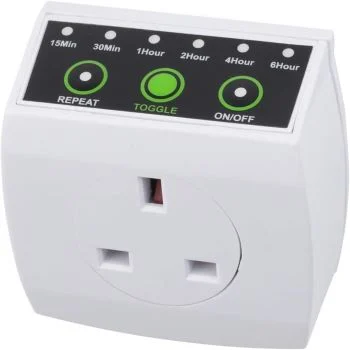
Budget Pick — 15 minutes to 6 hours, 13A rated
A simpler, cheaper countdown socket. Choose 15 or 30 minutes, or 1, 2, 4 or 6 hours, and the power is cut when the time is up. The listing gives it as 240V, 13A, with child protection on the socket.
At this price it is a convenience rather than a safety device. Keep it on the one or two hour setting while you are home, and swap it for a better one if it ever feels loose in the wall.
Countdown: 15 min, 30 min, 1, 2, 4 or 6 hours | Rating: 240V, 13A | Price: under £10
Fire Containment Bags
Size is the first thing to get right, so measure the length of your battery before you order. A compact bag will not take a long frame-mounted pack. Whichever you choose, the charging lead has to be fed through so the bag closes fully, and remember there is no UK standard for these bags: the temperature figures on the listings are the makers' own claims.
SAFE-TECH Lithium Battery Bag (14in)
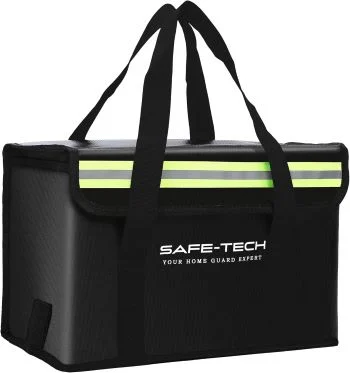
Compact Bag With Lab-Test Claims — SGS 800°C, UL94 V0
A four-layer bag of silicone, fibreglass and aluminium foil, sold by a UK fire-detection specialist. The maker says it meets SGS 800°C and UL94-5VA V0 fire ratings. Read that as the maker's claim, because there is no UK standard behind it, but it is the best-documented bag I found.
It measures about 35.5 x 19.8 x 24 cm, so it suits shorter packs, rack batteries and power-tool batteries. Check your pack fits before you buy.
Size: about 35.5 x 19.8 x 24 cm | Claim: SGS 800°C, UL94-5VA V0 | Price: around £25
FLASLD Lipo Safe Bag for Ebike Batteries (19in)

Longer Bag for Frame Batteries — about 49 cm, lower price
For long downtube packs. The listing gives the size as about 49 x 10.9 x 17.8 cm and quotes a temperature resistance of 1,000°F, which is roughly 538°C. It has a silicone-coated three-layer shell and a reflective strip.
The seller says plainly that it is designed to reduce the risk of fire rather than to survive a fire indefinitely, which is the right way to read any bag in this price range.
Size: about 49 x 10.9 x 17.8 cm | Claim: 1,000°F (about 538°C) | Price: around £20
Heat Alarms for the Charging Area
A heat alarm responds to temperature rather than smoke, which is why it suits garages, lofts and kitchens where a smoke alarm would give false alarms. It is an extra warning, not a replacement: keep working smoke alarms as well, and follow the maker's instructions for where to fit it. Look for BS 5446-2 on the box.
FireAngel FA6720-R Heat Alarm
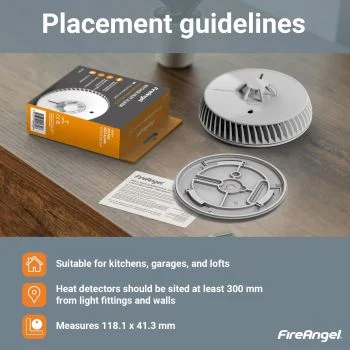
Best Value Heat Alarm — BS 5446-2, 10-year battery
A standalone heat alarm with a sealed 10-year battery. The listing states CE and UKCA marks and certification to BS 5446-2:2003. It fits on a removable baseplate, has a silence button and a quiet test function, and the baseplate matches the older FireAngel HT-630, so replacing one is simple.
It is a ceiling or wall alarm for the room or hallway where the battery charges. It will not tell you a pack is failing, but it will sound once the temperature rises.
Standard: BS 5446-2:2003 | Battery: sealed, 10-year | Price: around £12
BLACK+DECKER Kitchen Heat Alarm
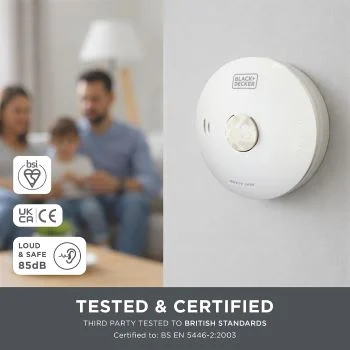
Kitemark Option — BS 5446-2:2003, 10-year lithium battery
A thermistor heat alarm with a sealed, tamper-proof 10-year lithium battery. The listing states it is third-party approved and BSI Kitemark certified to BS 5446-2:2003, and it is sold by Amazon.
It has an alarm memory: if it sounds while you are out, the red light keeps flashing for 72 hours afterwards, so you know it triggered. Despite the name it is fine outside the kitchen, in a garage or utility room.
Standard: BS 5446-2:2003 (BSI Kitemark per listing) | Battery: sealed, 10-year lithium | Price: around £13
Do not buy these
Universal chargers. Electrical Safety First: “Don't be tempted to buy one of these universal chargers you can get on online market places. They're designed to fit any type of battery and quite often the voltage is incorrect and incompatible.” OPSS guidelines specifically require the protection system to prevent thermal runaway when charging with an incompatible charger.
Batteries and chargers bought separately. The OPSS guidelines require a battery's protection system to cope with an incompatible charger precisely because mismatched parts are a known risk. If you are mixing and matching, you are running an experiment on your kitchen floor.
Anything with an unfused two-pin plug. That is the specific defect OPSS reported on the KENDA charger on 21 September 2026. A fused BS 1363 plug is the bare minimum.
High-power conversion kits over 250W. Legal to buy, illegal to ride, and a good way to end up charged with driving without a licence – or watching your bike get crushed under the Road Traffic Act.
You Cannot Put This Out. Please Read It.
This is the section most safety advice on the internet gets wrong, so it is worth being blunt.
Electrical Safety First, speaking to the BBC, was direct: what people often call smoke from a failing battery is venting, and that is toxic gas. You “can't put these fires out in a normal way, with a fire extinguisher or blanket”. RoSPA's Becky Guy explained why these fires are so unforgiving – the battery enters thermal runaway, overheats rapidly, and produces an intense fire that spreads very quickly.
So if you see venting:
Get out of the building as fast as you can and call 999. Do not go back for the bike, the battery or the charger. Stay well clear and wait for the fire service.
A containment bag is a cheap extra, not a safeguard. It is not for fighting a fire, and no bag is proven to hold back toxic gas. The rules above and a working smoke alarm do the real work.
The Workshop Checklist for E-Bike Battery Fire Safety
What I actually look at when a customer brings an e-bike in for a battery health check, in the order I check it.
1. Case and mount. Swelling shows in the gap between the pack and its cradle. A pack that no longer sits flat is a pack that is done – stop using it and do not charge it in the house.
2. Connectors. Look for green bloom, heat discolouration or a plug that needs wiggling. Water ingress at the terminal is the common cause and it is repairable.
3. Charger. Read the label. Wrong voltage, wrong current, or a multi-charger that has been reconfigured. This is the item most often bought second-hand from a marketplace.
4. Cell balance under load. The BMS report tells us whether cells have drifted apart. This is the test that catches a pack before it becomes dangerous, and it is why a health check is worth more than a voltage reading.
5. Full charge and discharge curve. If it will not reach 100%, or collapses under load, the pack has lost cells. That is a replacement conversation, not a repair one.
6. Where it charges. Not something the bench can check, but it matters most: a hard surface, a room with a working smoke alarm, a clear route to the door, and never where anyone is asleep.
The Short Version of E-Bike Battery Fire Safety
Charge while you are home and awake. Never block a way out. Use only the charger made for the battery. Unplug it once it is full. Act on the five Ss the moment you see one. That is e-bike battery fire safety in five sentences, and the products above only help at the edges of it.
E-Bike Battery Fire Safety FAQ
Related Articles & News!
Fuel prices up. Bus fares up. Car insurance up. After 30 years fixing bikes in Bournemouth, I've watched the electric bike market transform from [...]

With over 57,000 bikes stolen in the UK every year and nearly 15,000 cyclists injured in road accidents, bike insurance isn't just a luxury [...]

Left a bike at a station for more than 2 hours? Until January, British Transport Police would not investigate. That policy is gone — [...]
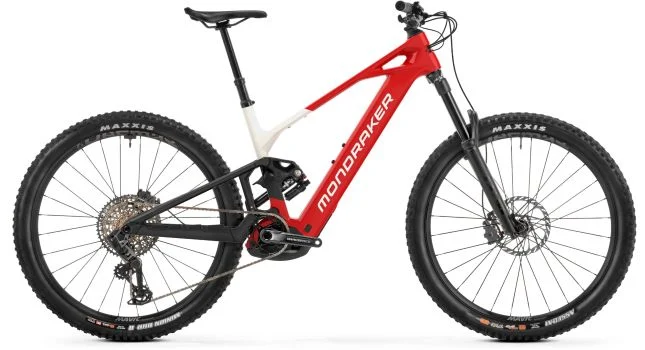
Mondraker Crafty Carbon R 2026 A full-power e-MTB built for demanding terrain. The Crafty Carbon R blends a carbon chassis, Fox 38 suspension, [...]
Continental's most aerodynamic road tyre now in 32mm. The Aero 111 was already the aero pick for 26mm and 29mm — developed with DT [...]
Most UK garages weren't built to store a bike — they were built to store a car, and the bike ends up leaning against [...]

DJI made the drones that film Hollywood. Now they've made the most powerful e-bike motor in the UK. After 30 years fixing bikes in [...]

84% of Brits can't tell a legal EAPC from an illegal moped — and most fires trace to the same confusion. The new E-bike [...]